Call For A Quote
866-296-3868
866-296-3868
If you run a tent rental operation, permitting is the part of the job that decides whether your event happens. The tent can be perfect, the crew can be early, and the whole install can still be shut down on the morning of the event because a piece of paper was missing.
The frustrating part is that there is no single national answer. Requirements are set at the state level, then amended at the county and city level, and enforced by whoever holds jurisdiction over your specific address. Two events forty miles apart can face genuinely different rules.
This guide explains how tent permitting actually works in the United States, what almost universally triggers a permit, what documentation you will be asked for, and — most usefully — how to find the exact authority that governs your event.
Before you read further: the information below reflects our practical experience supplying commercial tents to rental operators across the country. It is general guidance, not a legal reference. Fire codes vary by state, county and municipality, and they change. Always verify the requirements for your specific location with your local fire marshal or building department before you install.
Most U.S. jurisdictions base their tent rules on Chapter 31 of the International Fire Code (IFC), which covers tents and other membrane structures. Under IFC Section 3103.2, the baseline is straightforward:
Tents and membrane structures with an area over 400 square feet generally may not be erected, operated or maintained without a permit and approval from the fire code official.
Four hundred square feet is small. A single 20’x20’ frame tent is exactly 400 square feet — right at the line. A 20’x30’ is 600 and clears the threshold easily. In practice, most commercial installations require a permit.
But that number is not universal. Virginia, for example, amends the threshold upward to 900 square feet. Other jurisdictions lower it, apply it differently to open canopies versus enclosed tents, or count multiple adjacent tents as a single structure. The 400 sq ft figure is the starting point for your research, not the answer.
Square footage is not the only thing that pulls you into permitting. The IFC also addresses:
States adopt one of three broad approaches. Knowing which applies to you determines where to start looking.
| Approach | What it means for you |
|---|---|
|
International Fire Code (IFC) The most widely used model code |
Start with IFC Chapter 31, then check your state’s amendments and the edition year your state has adopted. Editions differ — a 2012 IFC jurisdiction and a 2021 IFC jurisdiction are not identical. |
|
NFPA 1: Fire Code Adopted or enforceable in a substantial minority of states |
NFPA 1 addresses tents and membrane structures with its own provisions. Some states enforce both NFPA and IFC-derived rules in different contexts. |
|
State-specific codes Notably California, New York and Oregon |
These states maintain their own fire codes, typically derived from IFC or NFPA but with extensive amendments. California additionally operates State Fire Marshal registration for flame-resistant fabrics under Title 19. |
|
No statewide mandate A small number of states |
Everything is set locally. There is no state-level answer to find — go directly to the city or county fire marshal. |
An important honest note: published counts of which states use which code disagree with each other, and adoptions change as states move to newer editions. We are deliberately not publishing a state-by-state table of thresholds and lead times, because a number that is out of date is worse than no number at all — especially when someone plans an event around it. Use the method in the next section to get an authoritative answer for your address.
The organization with final say is called the Authority Having Jurisdiction (AHJ). Finding yours takes about ten minutes.
Write down the answers and keep them per jurisdiction. If you serve the same counties repeatedly, this becomes a permanent operational asset — after a season you will have your own reference table that is more accurate than anything published online.
The fire marshal is the obvious approval. For several kinds of event there is a second one that operators discover late, and it is usually the slower of the two.
| Setting | The approval people forget |
|---|---|
| Restaurants & breweries | Health department requirements where food is served under the tent, plus the temporary-structure clock on a year-round patio |
| Car dealerships and grand openings | Planning and zoning temporary use permits, and separate signage ordinances covering banners, inflatables and searchlights |
| Wineries & vineyards | Agricultural zoning, which frequently caps the number of events per year regardless of what the fire code allows |
| Firework stands | State fireworks regulation on top of everything else — some jurisdictions prohibit tented retail outright |
| Schools and municipalities | District or city approval, which runs on its own calendar and is often slower than the fire permit |
| Trade shows and stadium lots | Venue and show management rules, frequently stricter than the city’s — and almost always prohibiting stakes |
If your event falls into one of these, start with the second column. The fire permit is rarely the bottleneck.
Requirements vary, but a typical commercial tent permit application asks for most of the following:
| Item | Notes |
|---|---|
| Flame resistance certificate | The certificate for your tent top and sidewall fabric. Most U.S. jurisdictions name NFPA 701 specifically. Download yours here. |
| Tent Identification and Warning label | The physical label attached to the tent top. Inspectors check for it on site. Do not remove it. |
| Site plan | Tent dimensions and placement, distance to structures and property lines, exits, and access routes for emergency vehicles. A site survey before you quote is where most of this information should already exist. |
| Floor plan | Required at occupant load 50+. Seating layout, egress paths, exit locations and widths. |
| Anchoring plan | Stake specification for soft ground, or ballast weight per leg for hard surfaces. See our guide to anchoring on concrete and asphalt, and the Ballasting Guide for weights. |
| Fire extinguisher placement | Type and number vary with tent size and whether cooking is present. |
| Heating and electrical details | Equipment type, fuel source, and clearances. See generator sizing and power planning. |
| Certificate of insurance | Frequently required, sometimes naming the municipality as additional insured. Our insurance guide covers what to carry. |
In our experience supplying rental operators, denials and failed inspections cluster around a short list of causes — and almost none of them are about the tent itself:
A 20’x20’ tent is exactly 400 square feet, which sits right at the common IFC threshold. Many jurisdictions require a permit at “in excess of 400 square feet,” which would place a 20x20 just under — but local amendments, sidewalls, occupant load and cooking can all change that. Confirm with your AHJ rather than assuming.
Private residential use of a small tent usually does not require a permit. Thresholds still apply, though, and a large tent or a residential event open to the public can cross the line. If the tent is over the local threshold, the property being private does not automatically exempt it.
Ten to thirty days is typical, but some jurisdictions require more for large occupancies. Apply as early as your event details are firm. Late applications are one of the most common reasons events lose their tent.
This depends on your contract and on local practice. Many jurisdictions will issue to either party. Whatever the arrangement, put it in writing in your rental agreement, because the party that assumed responsibility informally is rarely the party the fire marshal contacts. See our guide to contract clauses that matter.
No. The certificate is one document within the permit application, not a substitute for it. It proves fabric flame resistance only — it says nothing about anchoring, egress, occupancy or electrical, all of which are inspected separately.
Consequences range from fines to a stop-work order requiring the tent to come down before the event. For a rental operator the reputational cost with the client usually exceeds the fine.
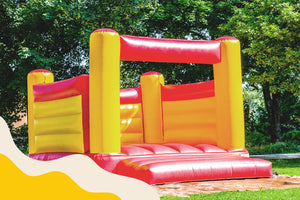
No, and this surprises people. Several states regulate commercial inflatables as amusement devices, with registration and inspection requirements entirely separate from tent permitting. See commercial inflatable certification by state.
Every Beyond Tent commercial tent ships with a Tent Identification and Warning label, and NFPA 701 certificates are available for download at any time.
Download your NFPA 701 certificate →
Working in a specific segment? Our industry and event guides cover the permitting quirks for each one.
Questions about a specific jurisdiction? Call 866-296-3868 or email sales@beyondtent.com. Se habla español.
Beyond Tent supplies commercial event equipment. We are not a testing laboratory, a certifying body, a code-enforcement authority, or a law firm.
The information in this article reflects our practical knowledge and experience in the event equipment industry and is offered in good faith for general informational purposes only. It is not legal advice and it is not a substitute for the fire code that applies to your location.
Fire codes, permit thresholds, application lead times and inspection requirements vary by state, county and municipality, and they change over time. Model codes are also adopted in different editions by different jurisdictions. We strongly recommend that you verify the specific laws and requirements of your state and local jurisdiction with your local fire marshal or building department before installing any tent.
Beyond Tent accepts no liability for permit denials, inspection failures, fines, delays, property damage, injury or other loss arising from reliance on the information in this article. Last updated: September 2026.
{"one"=>"Select 2 or 3 items to compare", "other"=>"{{ count }} of 3 items selected"}