
A festival is not one tent problem. It is fifteen tents that have to relate to each other, to crowd flow, and to a fire code that cares about the gaps between them at least as much as the structures themselves.
Beyond Tent supplies commercial-grade tents, staging, crowd control and event equipment to festival organisers, fairs, municipalities and event production companies across the United States, shipping from six US locations.
What a festival site needs
- Vendor and craft rows — typically 10’x10’ stalls in runs, the largest tent count on most sites
- Food court, which has its own separation and fire requirements because of cooking equipment
- Main stage cover and side-stage areas
- Beer garden or bar, often a fenced and separately controlled area
- VIP and sponsor hospitality, usually the highest-revenue square footage on site
- Ticketing, entry and will-call
- First aid and welfare, which your permit may require explicitly
- Artist, staff and volunteer areas back of house
- Seating and shade for the public, which reduces heat incidents and keeps people on site longer
Fire lanes and the aggregate area rule
This is the part that catches first-time organisers, and it is worth understanding before you draw a site plan.
Tents placed close together are frequently assessed as one combined structure. Under the International Fire Code and most codes derived from it, tents that are not separated by a required minimum distance may have their areas added together for permitting purposes — which can push a row of small vendor canopies over a threshold that none of them crosses individually, triggering requirements you did not plan for.
Codes commonly require separation between adjacent tents and a greater distance from permanent structures, property lines and parked vehicles, plus clear fire apparatus access lanes through the site. The exact distances vary by jurisdiction and by how your AHJ interprets them.
Do this early: take your draft site plan to the fire marshal before you commit to a layout or order equipment. Redrawing on paper is free. Moving forty tents on setup morning is not. Our permit guide covers what triggers review.
Sizing
| Use | Typical size | Notes |
|---|---|---|
| Vendor stall | 10’x10’ | Industry standard; sell in these units |
| Double stall / food | 10’x20’ | Cooking equipment needs the depth |
| Info, first aid, ticketing | 10’x20’ or 20’x20’ | Queue space matters as much as booth space |
| Beer garden / bar | 20’x40’+ | Fenced, controlled entry |
| VIP hospitality | 20’x40’ to 40’x60’ | ~50–170 with seating and service |
| Public seating / shade | 40’x60’+ | Clear-span matters for sightlines |
Frame tents are clear-span with no centre pole, which is what makes them work for stages, seating and anywhere the public needs to move freely. Pole tents cover large areas economically where a centre pole is acceptable.
Anchoring across a mixed site
Festival grounds are rarely one surface. Grass, gravel, asphalt and paved plaza all behave differently, and one anchoring plan will not cover the whole site.
- Stakes and straps on soil — but locate irrigation and utilities first. On a municipal park this is not optional.
- Ballast on any paved surface. See hard-surface anchoring.
- A single site-wide wind action plan with one named decision-maker and a defined threshold. With crowds on site, this is the plan that matters most and the one most often missing.
Equipment
Staging
Portable staging for main and secondary stages, ceremonies and presentations.
Crowd management
Crowd control fencing for queues, controlled-access areas, stage barriers and site perimeter. On a festival site this is as fundamental as the tents.
Flooring
Event flooring and carpet for mud management, accessibility and high-traffic paths. One wet day turns an unfloored field into the thing people remember about your festival.
Lighting and effects
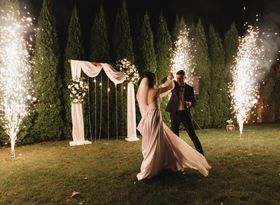
Event lighting, string lights and special effects including fog, cold sparks and confetti.
Concessions
Concession equipment for organiser-run food and drink.
Attractions
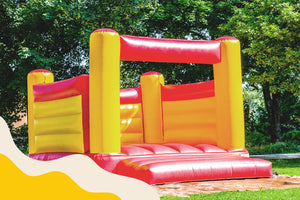
Commercial inflatables, interactive games and trackless trains for family areas. See our inflatable safety and compliance guide for anchoring, wind limits and state requirements.
Furniture
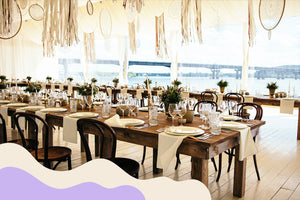
Tables, chairs, picnic tables and cocktail tables.
Planning a festival site? Send us your layout and expected attendance and we will help you specify the tent package — including where a different size solves a separation problem your current plan creates.
Volume pricing on multi-unit orders. Financing available. See options.
866-296-3868. Se habla español.
Common questions
Do we need a separate permit for each tent?
Usually the event is permitted as a whole, but the site plan must show every structure with dimensions and separations. Some jurisdictions permit large tents individually. Ask your AHJ how they handle it — the answer varies more than you would expect.
How far apart do tents need to be?
It depends on your jurisdiction, the tent sizes and what is around them. There is a required minimum in most codes, and failing it can cause your tents to be assessed as one large structure. Get the number from your fire marshal in writing before you finalise the layout.
Are your tents NFPA 701 certified?
Yes. Certificates are available to download for your permit file. Expect to submit them for every structure on site.
Should we buy or rent for an annual festival?
If you run one event a year, renting is usually right. If you run a series, or you are a municipality with multiple events across a season, buying typically pays back quickly. Our ROI guide shows how to run your own numbers.
What about cooking under tents?
Cooking equipment under or near a tent has its own rules — separation distances, extinguisher requirements and sometimes a prohibition on cooking under the structure at all. Never use open flame under a tent. Confirm specifics with your fire marshal.
Talk to us
Call 866-296-3868 — Mon–Fri, 9:00 AM to 6:00 PM EST
Email sales@beyondtent.com
Shop commercial tents →