Call For A Quote
866-296-3868
866-296-3868
Power is the part of an outdoor event that nobody thinks about until it fails, and when it fails it fails publicly. The lights go out during the first dance, the blower stops and an inflatable sags with children inside, or the coffee urn trips a breaker and takes the DJ with it.
Almost all of it traces back to the same two mistakes: nobody added up the load before the event, and nobody accounted for the surge that motors draw when they start.
This article covers how to inventory what you are actually powering, why starting watts matter more than running watts, how much headroom to leave, and the distribution errors that cause problems even when the generator is large enough.
Every powered device has a running wattage — what it draws in steady operation. Anything with an electric motor also has a starting wattage, a brief surge as the motor spins up that can be substantially higher than its running draw.
This is the detail that catches people out. Inflatable blowers, fans, pumps, compressors and some concession equipment all have motors. A blower that runs comfortably within your generator's capacity may still trip it at the instant of startup, particularly if several units start at once.
Size your generator against total starting load, not total running load. A generator that handles the steady state but not the surge will fail you at the least convenient moment.
Two practical consequences follow. First, when adding up your load, use the starting figure for anything with a motor. Second, stagger your startups — bring motorised equipment online one at a time rather than energising everything simultaneously.
There is no substitute for reading the nameplate. Every piece of equipment carries a label or a specification sheet stating its electrical requirements, and those figures vary meaningfully between models that look identical. A guide like this one cannot tell you what your specific units draw; the manufacturer can.
Work through the event category by category.
Modern LED string lighting and LED fixtures draw very little, which is why lighting is rarely the problem. Older incandescent or halogen fixtures draw dramatically more. If the lighting package is LED throughout, it will likely be a small fraction of your total.
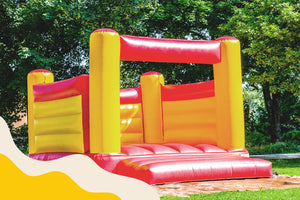
Blowers run continuously for the entire event, so their load is constant rather than intermittent, and each unit typically needs its own dedicated supply. Multiple inflatables mean multiple continuous motor loads plus multiple startup surges. This is frequently the largest single category at a family event and the one most often underestimated.
Fog, haze and snow machines contain heating elements, and heating elements draw heavily. Their duty cycle is intermittent — they draw hard while heating, then less — but you must size for the peak, not the average. Cold spark machines and similar equipment have their own requirements worth checking specifically.
This is where budgets and generators both get stressed. Electric heating is extremely power-hungry, which is why most commercial tent heating is propane or diesel rather than electric — though those units still typically need power for fans and controls. Evaporative coolers and portable air conditioning draw substantially. If climate control is in scope, price and size it first, because it will dominate everything else.
Coffee urns, warming equipment, fryers, popcorn machines and refrigeration are all heavy draws, and caterers routinely arrive with more equipment than they mentioned. Ask specifically and in writing what they intend to plug in.
Sound systems, projectors, screens and charging draw modestly by comparison, but sensitive electronics benefit from clean, stable power. A generator running near its limit produces less stable output, which is another argument for headroom.
Do not size a generator to exactly match your calculated load. Running any generator continuously at or near its maximum is hard on the machine, produces less stable power, and leaves no margin for the equipment nobody told you about.
Leaving meaningful spare capacity — a healthy margin above your calculated peak — is standard practice for good reason. Something will be added. The caterer will bring a second warmer. The client will ask for one more string of lights. A cool evening will turn the heaters on earlier than planned.
Headroom also matters for fuel and runtime. A generator working hard burns fuel faster, and refuelling mid-event is disruptive at best. Plan runtime for the full event plus setup and strike, and plan how refuelling happens if it is needed.
A correctly sized generator can still deliver an unreliable event if the distribution is wrong.
Long cable runs cause voltage drop, and undersized cable over distance is a genuine hazard as well as a performance problem. Motors are particularly sensitive — a blower fed through inadequate cable at the far end of a field may run hot and fail.
Balance your circuits rather than daisy-chaining everything into one outlet. Keep heavy motor loads separate from sensitive audio and lighting where you can. Use outdoor-rated cable and connectors, and protect runs from foot traffic, vehicles and standing water.
Ground fault protection is essential outdoors, particularly around any water feature, catering area or inflatable water slide. Wet grass, temporary power and hundreds of guests is a combination that deserves respect.
Generators produce carbon monoxide, which is colourless, odourless and lethal. Never operate a generator inside a tent, under a canopy, or in any enclosed or partially enclosed space. Site it well clear of the tent and away from where guests gather, accounting for wind direction.
Consider noise as well — a generator sited for convenience frequently ends up sited next to the ceremony. Position it downwind, distant, and screened if possible.
Shut down and allow cooling before refuelling. Keep fuel stored safely away from the unit and from any ignition source. And check whether your venue or local authority has specific requirements for temporary power, because many do.
For a modest setup with a few LED strings and one inflatable, careful arithmetic and good cable will serve you.
For large events, multiple heavy loads, three-phase equipment, anything involving temporary distribution panels, or any situation where you are uncertain, bring in a licensed electrician or a professional power contractor. Temporary power at scale is a specialist trade, and the cost of getting it right is small against the cost of getting it wrong in front of several hundred guests.
We can supply the equipment specifications for the lighting, effects, heating, cooling and concession products we carry, so you can build an accurate load inventory before you book a generator.
866-296-3868 • sales@beyondtent.com • Mon–Fri, 9:00 AM to 6:00 PM EST. Se habla español.
Important safety disclaimer. Beyond Tent supplies commercial event equipment. We are not licensed electricians, electrical engineers or power contractors.
This article is general educational information reflecting our practical experience in the event equipment industry. It is not electrical advice, engineering advice, or a substitute for the manufacturer's specifications for your equipment or the applicable electrical code. We have deliberately not published specific wattage figures for equipment types, because electrical requirements vary significantly between models — always read the nameplate or manufacturer documentation for the specific units you are operating.
Temporary electrical power presents risk of fire, electric shock, carbon monoxide poisoning, serious injury and death. Electrical codes and permitting requirements vary by jurisdiction. We strongly recommend engaging a licensed electrician or qualified power contractor for any installation involving significant load, temporary distribution, or any circumstance where you are unsure.
Beyond Tent accepts no liability for injury, death, fire, equipment damage, event disruption or other loss arising from reliance on the information in this article. Last updated: August 2026.
{"one"=>"Select 2 or 3 items to compare", "other"=>"{{ count }} of 3 items selected"}