Call For A Quote
866-296-3868
866-296-3868

Ask any event professional what the most common guest complaint is at a summer tent event, and heat is near the top of the list every time. The good news is that cooling a tent isn't a single product decision — it's a range of options, and matching the right one to the right event is mostly a question of how enclosed the tent is, how large it is, and what the client is willing to spend.
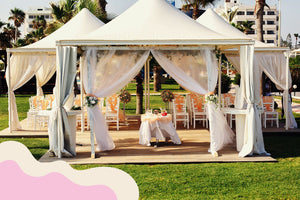
For tents with open or partially open sides — think backyard parties, casual receptions, or daytime events — misting fans are usually the right starting point. They're inexpensive to own and operate, require no ductwork, and do a good job of making an open tent feel noticeably more comfortable. Their limitation is exactly what makes them affordable: they don't meaningfully cool an enclosed space, and they add humidity, which can be a problem for events with dance floors, linens, or electronics.
Once a tent has solid sidewalls — common for weddings, corporate events, or anything booked with weather contingency in mind — a portable spot cooler becomes the more realistic option. Spot coolers are sized in BTUs, and matching capacity to tent size is the most important decision in this category: undersizing leads to a unit running constantly without actually cooling the space, while oversizing wastes rental cost and power capacity you may need elsewhere. As a rough starting point, plan on requiring meaningfully more cooling capacity per square foot for a fully enclosed tent than an open one, and always confirm ceiling height and sidewall coverage before recommending a unit size to a client.
Bear in mind that adding sidewalls does more than change the cooling load — it changes how the structure behaves in wind. See our sidewall selection guide before committing a client to full enclosure.
For large weddings, multi-day corporate activations, or any event where the client has no tolerance for temperature swings, ducted HVAC systems are worth the investment. These systems distribute conditioned air more evenly than a single spot cooler and can maintain a consistent temperature regardless of outdoor conditions — but they come with a higher rental cost, require more setup time, and typically need a larger generator or dedicated power drop to run reliably.
Whichever option a client chooses, cooling equipment is almost always one of the largest power draws at a tented event — often larger than lighting or sound combined. Before quoting a spot cooler or HVAC unit, confirm what else is running on the same circuit or generator, since an undersized generator is one of the most common (and most avoidable) event-day failures. Our guide to generator sizing and power planning walks through the load calculation.
At most events, cooling is about guest experience. In a few settings it is closer to a duty of care, and those are worth treating differently when you quote them.
As a general framework: open-sided tents and casual daytime events call for misting fans, sidewall tents with moderate guest counts call for one or more spot coolers, and large enclosed tents with no room for error call for full HVAC. Building all three tiers into your rental fleet — rather than just one — lets you quote the right solution instead of talking every client into (or out of) more cooling than they actually need.
The same logic runs in reverse at the other end of the season. Heaters and sidewalls are what let a restaurant patio trade through winter or a gameday hospitality tent survive a November kickoff — and for a rental operator, extending the season at both ends is the single most direct way to improve utilisation. Our fleet ROI guide covers why that matters more than the purchase price.
{"one"=>"Select 2 or 3 items to compare", "other"=>"{{ count }} of 3 items selected"}