Call For A Quote
866-296-3868
866-296-3868
Event tent and party rental terminology gets thrown around a lot — in quotes, spec sheets, permit paperwork, and sales conversations — and it's not always used consistently from one supplier or one city to the next. This glossary collects the terms we get asked about most often, grouped by category, in plain language. Where we've published a full guide on a term, we've linked it so you can go deeper.
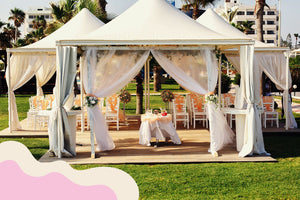
Frame Tent — A tent supported by an aluminum or steel perimeter framework instead of interior poles. This leaves the entire interior space open and unobstructed, and allows setup on both hard surfaces (asphalt, concrete) and soft ground. See our Complete Guide to Choosing the Right Frame Tent Size.
Pole Tent — A tent held up by one or more center poles beneath the fabric roof, with the shape defined by exterior guy ropes staked into the ground around the perimeter. Requires more surrounding ground space than a frame tent and is generally limited to grass or soil. See our Commercial Pole Tents guide.
Marquee Tent — A term with three overlapping meanings: (1) in British/European usage, a general word for any large event tent; (2) a style descriptor for a classic, peaked, symmetrical tent silhouette; and (3) a specific frame tent product line name used by manufacturers, including Beyond Tent's own Marquee Frame Tent, which is structurally a frame tent with no center poles. Read our full Marquee vs. Frame Tent terminology guide.
Bell Tent — A round, single-center-pole tent with a conical roofline, popular for glamping-style rentals, boutique weddings, and lounge spaces rather than large-capacity events.
Gable Tent / Gable End — A frame tent with a peaked, house-shaped end wall (as opposed to a flat or curved end), often chosen for a more traditional architectural look.
Clear Span (Engineered) Structure — A large-scale tent structure using heavy-duty aluminum box beams or keder-track extrusions instead of standard tent framing, engineered to span wide distances with no interior support at all. Typically used for large corporate, sporting, or long-term installations. See Non-Engineered vs. Engineered Tents.
Hip End — The sloped roofline running from a tent's corner up to its peak or ridge line, as opposed to a flat gable end.
Eave — The lowest edge of a tent's roofline, where the roof fabric meets the sidewall or leg — the point sidewalls and valances attach to.
Valance — The decorative strip of fabric that hangs down from the eave line, available in straight, scalloped, or catenary-curve styles, mainly for finished appearance rather than structural function.
High Peak vs. Low Peak — Describes how dramatic a tent's roofline is. High-peak designs (like the Marquee Frame Tent) have a taller, steeper roof for a more formal look; low-peak designs prioritize a lower overall profile, often for cost or wind-exposure reasons.
Blockout Vinyl — An opaque vinyl finish that blocks light from passing through in either direction, standard on most commercial tent tops and sidewalls for heat control, night-time privacy, and a cleaner finished look. Full explainer: Blockout vs. Translucent Vinyl.
Translucent Vinyl — Vinyl manufactured to let diffused daylight pass through. Used selectively — cathedral windows, some liners — rather than as a whole-tent material on most modern commercial tents.
Ounce (oz) Weight and GSM — The two competing units used to measure vinyl fabric weight: ounces per square yard (the North American standard) and grams per square meter (the metric/international standard). See our full conversion guide: GSM vs. Ounce (oz) Vinyl Weight Explained.
PVC-Coated Polyester — The base fabric used in almost all commercial tent tops and sidewalls: a polyester weave coated in PVC for water resistance, UV stability, and mildew resistance, typically produced in 10–18 oz. weights.
Cathedral Window Sidewall — A solid blockout sidewall with a clear or translucent panel inset, used to bring in light or a view without giving up full sidewall coverage. Covered in our Tent Sidewall Selection guide.
Tent Liner — A decorative fabric layer installed beneath the tent top's structural underside, used to hide framing and hardware and create a finished ceiling look for weddings and upscale events.
NFPA 701 — The National Fire Protection Association's standard test method for flame propagation in textiles and films. Tent vinyl that passes NFPA 701 has been tested to self-extinguish quickly and limit how far flame and char spread, and most jurisdictions require a valid NFPA 701 certification tag on tent fabric before issuing a permit. Source: NFPA 701, National Fire Protection Association.
AHJ (Authority Having Jurisdiction) — The government office or official — typically a local fire marshal or building department — with legal authority to approve or deny a tent permit and to require inspections. Source: National Fire Protection Association. Full explainer: What Is an AHJ?
Wind Rating — The maximum wind speed a tent structure is engineered to withstand when properly anchored per the manufacturer's specifications. See Understanding Wind Ratings & Snow Loads.
Snow Load — The maximum weight of accumulated snow a tent roof is engineered to bear before risking structural failure, relevant mainly for tents used in cold-weather regions or left up overnight in winter conditions.
Engineered vs. Non-Engineered Tent — Whether a tent's structural design has been certified by a licensed engineer for specific wind and snow load ratings (engineered) or is rated only under general manufacturer guidelines (non-engineered). Many AHJs require engineered stamps for tents above a certain size or occupancy.
COI (Certificate of Insurance) — A document from an insurance provider verifying that a rental business carries active general liability coverage, often required by venues, cities, and AHJs before a tent permit or venue contract is approved.
Additional Insured — A status added to a rental business's liability policy that extends coverage to a third party — typically the venue or event host — for claims arising from that specific event.
Deadweight / Ballast — Weighted blocks or barrels used to anchor a frame tent on surfaces where stakes can't be driven, such as asphalt or concrete. See How to Deadweight a Tent.
Tent Permit — Local government authorization required before erecting a temporary tent structure over a certain size or occupancy threshold, issued by the AHJ after reviewing safety documentation. See State-by-State Tent Permit Requirements.
Rate Card — A rental business's standardized price list for its inventory, used to quote jobs consistently rather than negotiating each price from scratch. See How to Price Your Rentals.
Fleet ROI — The number of rental bookings needed for a piece of equipment to pay back its purchase cost, a core metric for deciding what inventory to add next. See Tent Fleet ROI.
Damage Waiver — An optional fee charged to renters that limits their liability for minor accidental damage to rental equipment, in exchange for a flat charge rather than full repair/replacement cost.
Site Survey — An on-location assessment of ground conditions, access, overhead obstructions, and surface type performed before quoting a tent installation. See Site Surveys: What to Check Before You Quote a Tent Job.
Subfloor — A leveling platform installed beneath a portable dance floor or event flooring system when the ground underneath is uneven, soft, or sloped.
This glossary gets updated as new questions come in. If you've run into a term in a quote, contract, or permit application that isn't defined here, reach out and we'll add it.
{"one"=>"Select 2 or 3 items to compare", "other"=>"{{ count }} of 3 items selected"}