Call For A Quote
866-296-3868
866-296-3868
"Marquee tent" is one of the most inconsistently used terms in the event rental industry, and it trips up a lot of first-time buyers. Depending on who you're talking to, it can mean three different things — and only one of them is actually a distinct structural category.
In British and much of European English, "marquee" is simply the general word for a large event tent — full stop. A wedding marquee, a corporate marquee, a garden party marquee — the term doesn't specify a structural type at all. Historically, these tents were most often pole-supported, using center poles and exterior guy ropes staked into the ground around the perimeter, which is closer to what Americans would call a pole tent.
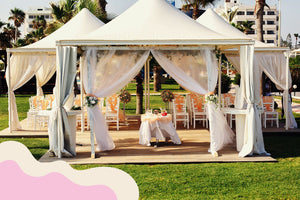
Separately, "marquee" gets used to describe a look — peaked rooflines, classic symmetrical proportions, an elegant silhouette associated with formal weddings and upscale events — regardless of what's actually holding the tent up.
Here's the part that catches buyers off guard: several commercial tent manufacturers, including Beyond Tent, use "Marquee" as the name of a specific frame tent product line — not a pole tent at all. Our own Marquee Frame Tent is a true frame tent: it's supported by an aluminum or steel frame with no center poles and no guy ropes, which means it can be installed on both hard and soft surfaces and leaves the entire interior open and unobstructed. It just happens to carry the classic peaked "marquee" look in its design.
So when a listing says "Marquee Frame Tent," the second word is doing the real structural work — it's a frame tent styled like a marquee, not a pole tent by another name.
| Feature | Pole Tent | Frame Tent (incl. "Marquee" styled) |
|---|---|---|
| Support | Center pole(s) + exterior guy ropes | Aluminum/steel perimeter frame, no center poles |
| Interior space | Obstructed by pole(s) | Fully open |
| Surface requirements | Needs staking room around the perimeter; grass/soil only | Can be set up on grass, asphalt, or concrete with deadweight anchoring |
| Typical footprint use | Open fields with room for guying | Tight lots, parking areas, backyards, hard surfaces |
Whenever "marquee" comes up in a quote or a listing, ask the more useful question directly: is this a pole tent or a frame tent? That answer tells you what surfaces it can go on, how much clearance you need around it, and what the interior space will actually look like — which matters far more than which name is printed on the spec sheet. For help sizing whichever structure fits your event, see our Complete Guide to Choosing the Right Frame Tent Size.
Related: Shop Marquee Frame Tents · Classic Series vs. Master Series Frame Tent · Full Glossary of Tent & Rental Terms
{"one"=>"Select 2 or 3 items to compare", "other"=>"{{ count }} of 3 items selected"}